What a Sui Gas Bill Actually Shows You
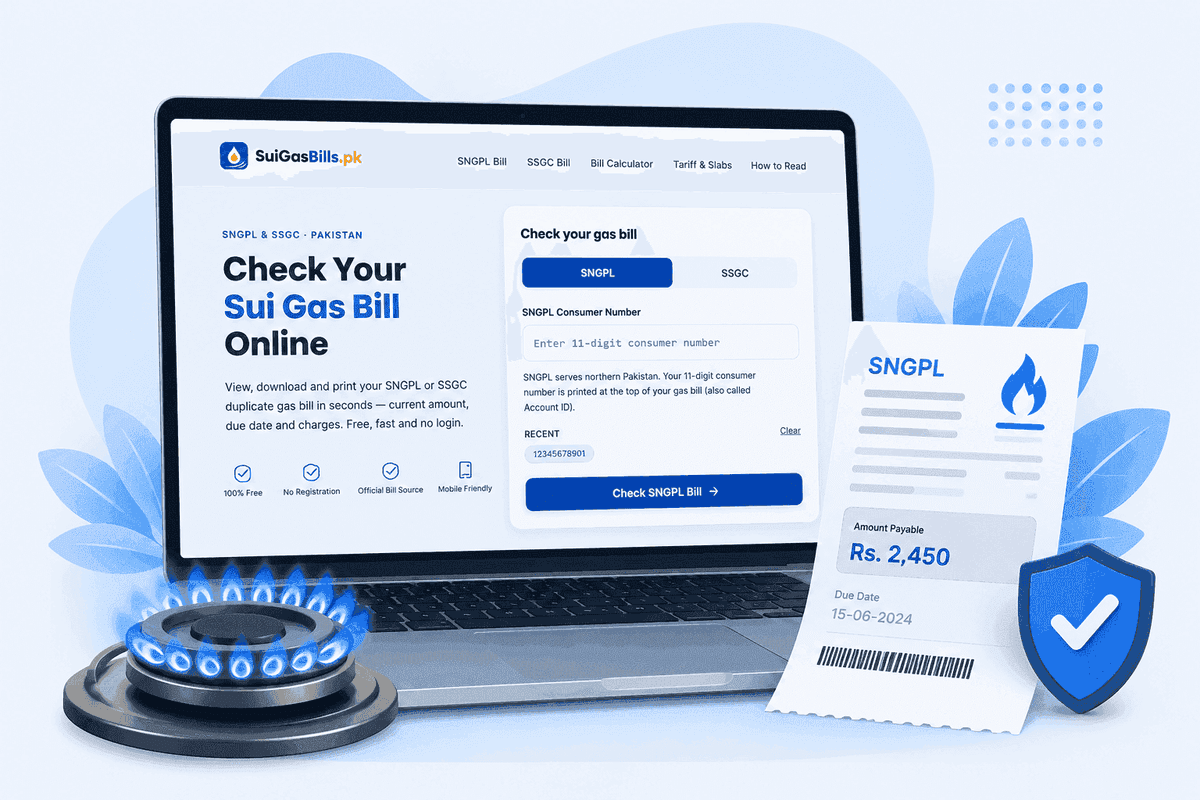
A Sui Gas bill is a monthly statement that records how much natural gas your household or business burned, converts that usage into money using OGRA-approved tariffs, and tells you exactly how much to pay and by when. Whether your supplier is SNGPL in the north or SSGC in the south, the layout follows the same logic, and once you can read one field you can read them all. This guide walks the bill top to bottom; if you first need to retrieve the document itself, our SNGPL bill check and SSGC bill check tools pull it up in seconds.
Reading your bill carefully is not just an academic exercise — it is how you catch overcharging, spot an estimated reading, and understand why winter bills spike. Every rupee on the bill is traceable to a meter reading and a published slab rate, so nothing should be a mystery. If a figure looks wrong, you have grounds to question it through the Sui Gas complaint channel, and you can independently model the expected amount with our bill calculator before you decide whether to dispute.
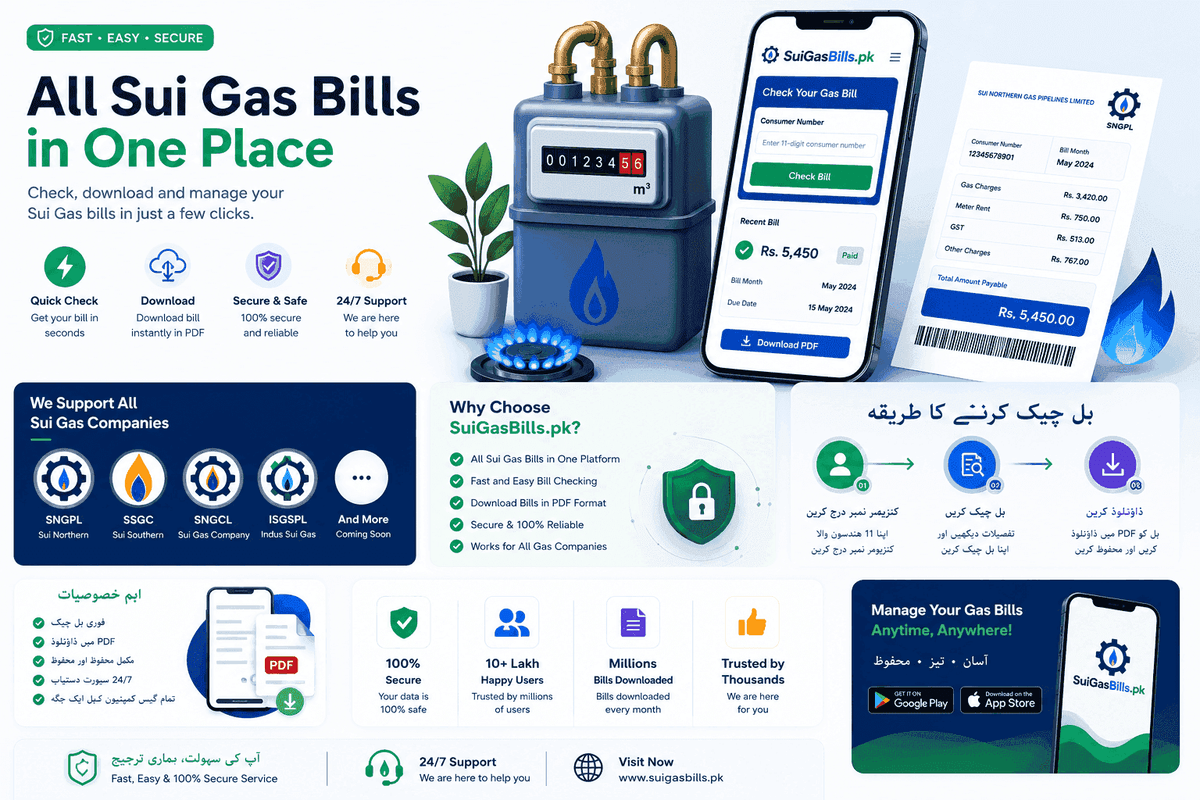
The bill is divided into recognisable blocks: an identity block (who you are and which billing month), a consumption block (meter readings and units), a charges block (energy, fixed charge, taxes and levies), and a payment block (due date, payable within and after due date). Our detailed how to read your bill reference page mirrors this structure, and the sections below expand each block with worked examples so you never have to guess what a number means again.
Keep in mind that tariff figures quoted here are OGRA-set, indicative and revisable; the printed bill in your hand is always the authoritative document. Rates were last notified effective 1 July 2025 and domestic slabs were left unchanged by OGRA's 24 November 2025 determination. For the full slab table and background you can read our 2025 tariff slab guide alongside this walkthrough.
The Top Block: Consumer Number, Billing Month and Issue Date
The top-left of the bill carries your consumer identity. For SNGPL this is an 11-digit Account ID or Consumer Number; for SSGC it is a 10-digit customer number. This is the single most important field on the page — it is what you type into the SNGPL bill check or SSGC bill check form, quote to the helpline, and use at any payment counter. It never changes for the life of the connection, even if you switch names or replace the meter, so it is worth memorising or photographing.
Beside the consumer number you will find your registered name, postal address and the meter serial number. Confirm all three match your premises before paying — if the name or address is wrong you may be looking at a neighbour's bill, which commonly happens after a mistyped digit. If your details are genuinely incorrect on the bill itself, that is a correction request you raise through the complaint channel or your regional office, not something to ignore.
The billing month tells you the period covered, and the issue date (or bill date) starts the clock on your due date. A bill issued in, say, early January covers December's consumption. Understanding this lag explains why a cold-weather spike sometimes appears a month later than you expect. If you have lost the physical bill and need the same document with all these fields, request a copy via our duplicate bill guide rather than guessing the amount.
You may also see a reference number or barcode used purely for payment routing, plus your tariff category label (domestic, commercial or industrial). The category drives which rate table applies, so a household accidentally billed as commercial will overpay substantially — a difference explained fully in our SNGPL vs SSGC comparison and worth checking on your very first bill after a new connection.
| Top-Block Field | What It Means | Why It Matters |
|---|---|---|
| Consumer / Account Number | 11 digits (SNGPL) or 10 digits (SSGC) | Used for all bill checks, payments and complaints |
| Consumer Name & Address | Registered account holder and premises | Confirms the bill is genuinely yours |
| Meter Serial Number | Physical meter identifier | Cross-check against the meter on your wall |
| Billing Month | Period of consumption billed | Explains the one-month lag on seasonal spikes |
| Issue / Bill Date | Date the bill was generated | Starts the countdown to your due date |
| Tariff Category | Domestic, commercial or industrial | Determines which slab rates apply |
Meter Readings: Previous, Current and Units Consumed
The consumption block shows three linked numbers: the previous reading (last month's meter figure), the current reading (this month's), and the difference between them, which is your units consumed. SNGPL and SSGC meters record volume in cubic metres (m³), and on the bill 1 hm³ equals 100 m³. Subtracting previous from current gives the raw gas volume you used — the foundation of every charge that follows. If you want to verify the current figure yourself, walk through our meter reading guide and compare it against your physical dial.
Look for a code indicating whether the reading was actual (a meter reader physically visited) or estimated (the utility projected your usage). Estimated readings, sometimes flagged with an 'E' or 'Avg', are a leading cause of billing disputes because they can overshoot in a mild month. If you spot repeated estimates, submit your own reading through the complaint page and read our overcharge dispute guide to understand how adjustments are applied in the next cycle.
The bill often prints a small consumption-history strip — a bar or table of the last several months' units. This is genuinely useful: it reveals your seasonal pattern and shows whether a high bill is a real usage jump or an anomaly. A sudden spike with no lifestyle change can indicate a leak or a faulty meter, both of which are safety and cost concerns covered in our gas safety tips.
Finally, note that units consumed in m³ are not yet money — they are energy volume that must be converted to MMBTU before slab rates apply, which the next section explains. To sanity-check the arithmetic from raw units all the way to a rupee figure, plug your previous and current readings into our Sui Gas bill calculator and compare the output to the printed total.
From Cubic Metres to MMBTU: The GCV Conversion
Here is the field most people miss. Your meter measures volume in cubic metres, but OGRA sets tariffs per MMBTU (Million British Thermal Units) — a unit of energy, not volume. To bridge the two, the bill uses the Gross Calorific Value (GCV), a heat-content figure for the gas supplied in your area, printed somewhere on the bill. GCV varies slightly by region because gas from different fields has different energy density. This conversion is why two households using identical cubic metres can see marginally different charges, as our OGRA tariff guide explains in depth.
The bill multiplies your consumed m³ by the GCV factor to produce your consumption in MMBTU, and it is that MMBTU figure the slab rates are applied to. You will typically see both numbers on the bill: the volume in m³ and the energy in MMBTU (or HM3 converted). Understanding this step demystifies why the 'rate' you remember in rupees does not simply multiply your cubic metres — the conversion sits in between, and our tariff slab guide shows the published Rs/MMBTU figures the bill actually uses.
You do not need to compute GCV yourself — it is fixed by the utility and audited — but knowing it exists helps you follow the money. If your MMBTU figure looks disproportionate to your m³ usage, that is worth querying through the Sui Gas complaint channel. For a hands-on check, our bill calculator performs the same m³-to-MMBTU-to-rupees conversion so you can reproduce the bill's logic line by line.
One practical takeaway: because charges are energy-based, conserving gas directly cuts your MMBTU total and therefore your bill. Simple measures — servicing appliances, insulating geyser pipes, and running heaters efficiently — reduce heat energy consumed, not just volume. We cover these bill-lowering habits alongside winter safety in our gas safety and conservation guide.
Gas Charges by Slab: How the Energy Charge Is Built
The energy charge (also called the gas consumption or variable charge) is the largest line on most bills, and it is built on a progressive slab system, not a single flat rate. As your MMBTU consumption rises, later units are billed at higher slab rates. This telescopic structure is deliberate — it keeps low-usage households cheap and prices heavy consumption steeply. The exact Rs/MMBTU figures for each slab appear in our 2025 tariff slab rates guide and on the official tariff page.
For protected domestic consumers, published slab rates run 200, 250, 300 and 350 Rs/MMBTU across the 0.25, 0.5, 0.6 and 0.9 hm³ bands. Non-protected domestic consumers face a much steeper ladder — 500, 850, 1250, 1450, 1900, 3300, 3800 and 4200 Rs/MMBTU across rising bands. Because the top slabs are so expensive, crossing into them in a cold month can multiply your bill, which is exactly why understanding your protected consumer status matters so much.
Crucially, most slab systems are cumulative within the applicable structure — different portions of your usage can be charged at different rates rather than the whole amount jumping to the top rate. The bill usually itemises this, showing units in each slab and the rate applied. If the breakdown is hard to follow, our bill calculator reproduces the slab arithmetic step by step, and our overcharge dispute guide explains how to challenge a slab that looks misapplied.
Remember these figures are OGRA-set, indicative and revisable — the notification effective 1 July 2025 governs the current bills, with domestic slabs unchanged by the 24 November 2025 determination. The bill in front of you is authoritative if a printed rate differs from a table you read online. For the regulatory background on how OGRA fixes these numbers, see our OGRA gas tariff guide.
| Consumer Category | Slab Structure (Rs/MMBTU) | Applies To |
|---|---|---|
| Protected domestic | 200 / 250 / 300 / 350 | Winter avg (Nov–Feb) up to 0.9 hm³/month |
| Non-protected domestic | 500 / 850 / 1250 / 1450 / 1900 / 3300 / 3800 / 4200 | Households above the protected threshold |
| Slab principle | Progressive — higher usage, higher rate | Later units billed at steeper rates |
Fixed Charge, Meter Rent and the Protected Label
Below the energy charge sits the fixed monthly charge — a flat amount you pay regardless of how little gas you burn. Its size depends entirely on your consumer category. A protected consumer pays Rs 600 per month; a non-protected consumer pays Rs 1,500 per month up to 1.5 hm³ (150 m³) and Rs 3,000 per month above that. This single label can change your annual cost by thousands of rupees, so verifying it on the bill is essential — confirm yours with the protected status checker.
The protected or non-protected label is printed on the bill, and it is determined by your average winter consumption from November through February. If that average stays at or below 0.9 hm³ (90 m³) per month you qualify as protected; exceed it and you drop to the non-protected fixed charge and slab rates for the following year. The full eligibility mechanics — and how to regain protected status — are laid out in our protected consumer status guide.
You may also see a small meter rent line, around Rs 40, covering the metering equipment. It is minor but legitimate. What you should scrutinise is the category label itself: a household wrongly flagged non-protected is overpaying on both the fixed charge and every slab. If your winter usage was modest but the bill shows non-protected, raise it through the Sui Gas complaint channel with your consumption history as evidence.
Because the fixed charge is unavoidable, the only lever you control is your consumption category, which in turn hinges on winter usage. Keeping November–February consumption under the protected threshold preserves the Rs 600 fixed charge and the cheaper slabs. Practical conservation tactics for the cold months are covered in our gas safety and conservation guide, and you can model both scenarios in the bill calculator.
- Protected consumer — Rs 600/month fixed charge, if winter (Nov–Feb) average is at most 0.9 hm³ (90 m³)/month; verify via the protected status checker
- Non-protected up to 150 m³ — Rs 1,500/month fixed charge
- Non-protected above 150 m³ — Rs 3,000/month fixed charge
- Meter rent — around Rs 40/month for metering equipment
- Category label — printed on the bill; dispute an error via the complaint page
GST, TV Fee and Other Government Levies
After the energy and fixed charges are totalled, the bill applies GST at 18% on that combined subtotal (energy charge plus fixed charge). GST is a federal tax that SNGPL and SSGC collect on the government's behalf — it appears as its own line and cannot be waived or negotiated. Every consumer pays it at the same rate, protected or not, and it is one of the reasons a raw slab rate never equals your final per-unit cost, as our tariff slab guide illustrates.
Some bills historically carried a television licence fee bundled into utility statements, though this varies by supplier and period. If a TV fee or any similarly labelled levy appears on your bill, it is a pass-through government charge, not a gas cost, and it will be clearly itemised. Anything you cannot identify is worth querying through the complaint channel rather than assuming it is a gas charge you must simply accept.
Because GST is calculated on the subtotal, it scales with your usage — a bigger energy charge means proportionally bigger GST. This compounding is why high winter bills feel especially steep: the slab jump inflates the base, and 18% GST then sits on top of that inflated base. Modelling your expected total with the bill calculator before the bill arrives helps you budget for the tax component, not just the gas.
Keep every itemised line in view when you cross-check a bill: energy charge, fixed charge, GST and any levy should each be individually visible and add up cleanly to the pre-arrears subtotal. If the arithmetic does not reconcile, that is concrete grounds for a dispute — our overcharge dispute guide walks through how to present the discrepancy and what resolution to expect.
Arrears, Adjustments and the Late-Payment Surcharge (LPS)
Arrears are amounts carried forward from previous unpaid or partially paid bills, and they appear as a distinct line added to your current charges. If you paid last month in full, this should read zero; a non-zero arrears figure means the system has not recorded a payment or a balance genuinely remains. If you paid but arrears still show, allow the normal 2–3 working days for bank and ATM payments to reflect, and consult our payment methods guide to confirm your channel's clearing time.
The late-payment surcharge (LPS), sometimes labelled a surcharge or after-due-date charge, is the penalty applied when a previous bill was paid after its due date. It is why the 'payable after due date' figure is higher than the 'payable within due date' amount. Understanding how LPS accrues — and how to avoid it — is covered fully in our due date and late payment guide, and it is entirely avoidable by paying on time through the payment page.
You may also see adjustment lines — corrections for a previously estimated reading, a meter test result, or a tariff true-up. Positive adjustments increase your bill; negative ones credit you. If an adjustment appears without explanation, or a bill you already paid still shows arrears after three working days, contact the helpline with your payment reference and, if needed, escalate through the complaint process as described in our complaint helpline guide.
Arrears compound quietly: an unpaid balance attracts surcharge, which then joins next month's arrears, and the total snowballs. If you cannot pay in full, a partial payment before the due date reduces the surcharge base for the next cycle — better than paying nothing. To stop the cycle entirely, reconcile every payment against the next bill and keep receipts, a discipline our overcharge dispute guide recommends for anyone questioning a balance.
| Line Item | What It Represents | Action If It Looks Wrong |
|---|---|---|
| Arrears | Unpaid balance from previous bills | Wait 2–3 days for payment to reflect, then query |
| LPS / Surcharge | Penalty for paying a past bill late | Pay on time to avoid; verify accrual if disputed |
| Adjustment | Correction for estimate, meter test or true-up | Request written explanation via complaint |
| Payable within due date | Amount if paid on or before due date | Target this figure |
| Payable after due date | Higher amount including surcharge | Avoid by paying early |
Due Date, Payable Within vs After Due Date
The payment block is where the bill tells you what to do. The due date is roughly 30 days from the issue date and is the last day you can pay the lower 'payable within due date' amount. Miss it and the higher 'payable after due date' figure — which bakes in the late-payment surcharge — becomes the amount owed. Paying on or before the due date is the single easiest way to keep your bill down, and every accepted channel is listed on our payment page.
The two-tier amount is printed side by side precisely so you can see the cost of delay at a glance. On a heavy winter bill the gap between the two figures can be several hundred rupees. Digital wallets clear fastest — a JazzCash or Easypaisa payment usually reflects the same day, as detailed in our JazzCash payment guide and Easypaisa payment guide — while bank and ATM payments take 2–3 working days, so pay those with a margin before the deadline.
If you are paying close to the due date, choose a same-day channel to be safe, and always keep the receipt or transaction reference. Payment posting delays are the most common reason a paid bill still appears outstanding, and knowing your channel's clearing window (covered in our payment methods guide) prevents needless panic. If a genuinely paid bill stays unpaid in the system, the complaint helpline guide shows how to get it manually reconciled.
Repeated late payment does more than add surcharge — a sustained default can lead to disconnection and a reconnection fee. If you routinely struggle with the due date, set a recurring reminder for a week before it, and consider checking the bill early each month via the SNGPL or SSGC portal so a large amount never surprises you. Full late-payment consequences are explained in our due date guide.
Verifying Your Bill and Fixing a Figure That Looks Wrong
Now assemble the whole picture. A correct bill reads as a clean chain: current reading minus previous reading equals units in m³; units convert via GCV to MMBTU; MMBTU passes through the slab rates to an energy charge; the fixed charge is added by category; 18% GST is applied to that subtotal; arrears and any surcharge are added; and the result is your payable amount. If you can trace that chain, you have verified the bill. Reproduce the arithmetic anytime with our bill calculator.
When a link in the chain does not add up, act on the specific field. A wrong reading is a meter dispute — see the meter reading guide. A misapplied category is a protected-status issue — check the protected status checker. A general overcharge follows the structured escalation in our overcharge dispute guide. Whatever the field, the entry point is the Sui Gas complaint channel, with the process detailed in our complaint helpline guide.
If you have simply lost the bill or the print is faded, do not estimate — retrieve an exact copy. Our duplicate bill guide and the duplicate bill tool return the same document with every field intact, and you can always re-pull the latest bill through the SNGPL or SSGC portal. Reading from the real document, not a guess, is the foundation of every dispute.
Finally, make bill-reading a monthly habit rather than a once-a-year scramble. Checking early, comparing your own meter photo, and watching the consumption-history strip will catch problems while they are small. Pair that with the conservation measures in our gas safety and conservation guide, and you will not only understand your bill — you will actively shrink it. For a quick monthly check, start at our Sui Gas bill home page.