
ٹیرف
سوئی گیس ٹیرف اور سلیب ریٹس
SNGPL اور SSGC کے موجودہ OGRA سے منظور شدہ سلیب ریٹس، فکسڈ چارجز اور GST دیکھیں — پروٹیکٹڈ اور نان پروٹیکٹڈ دونوں کنزیومرز کے لیے۔
Tariff Overview
What Is the Sui Gas Tariff? — Pakistan's Progressive Pricing System
Natural gas is the lifeblood of the Pakistani household. From cooking rotis on a gas stove in Lahore to heating water in a Peshawar winter, millions of families across the country depend on Sui gas supplied by two major utilities: Sui Northern Gas Pipelines Limited (SNGPL), which serves Punjab and Khyber Pakhtunkhwa, and Sui Southern Gas Company (SSGC), which distributes gas across Sindh and Balochistan. Both companies operate under a common domestic tariff framework approved by the Oil and Gas Regulatory Authority (OGRA).
The term “Sui Gas tariff” refers to the schedule of rates that determines how much money a residential consumer pays per cubic metre (m³) of gas consumed. Unlike a flat-rate utility, Pakistan's gas tariff employs a tiered slab structure — the more you consume, the higher rate you pay on the additional units consumed above each threshold. This progressive design serves two policy goals simultaneously: it keeps gas affordable for low-income households while recovering infrastructure costs from heavier consumers and cross-subsidising the poorest users.
The current tariff framework recognises two broad consumer categories: Protected consumers and Non-Protected consumers. Protected status is a government welfare designation intended to shield the most economically vulnerable households from high energy costs. Protected consumers receive substantially lower per-unit rates across every slab, as well as a lower fixed monthly charge. Non-protected consumers — generally those with higher incomes or larger houses — pay market-closer rates.
The tariff is not set arbitrarily. Under the OGRA Ordinance 2002, OGRA is mandated to determine gas tariffs in a transparent, consultative manner. Utility companies submit annual revenue requirement petitions; OGRA holds public hearings, reviews costs, and issues a determination that sets the slab rates and fixed charges effective from the beginning of each financial year (July 1). These rates are then gazetted in official notifications published in the Pakistan Gazette and are binding on both SNGPL and SSGC.
The current rates published on this page are effective for FY 2025–26 (indicative). OGRA revises these figures annually and sometimes mid-year via supplementary notifications. Consumers are encouraged to verify the latest gazette notification on the OGRA website or contact their respective utility company before making financial decisions based on these rates.
Rates verified: The official Rs/MMBTU schedule below was checked against SSGC Domestic Rates — official notification on 4 July 2026. It has been in effect since 1 July 2025 (OGRA notification dated 29 June 2025) and OGRA's FY 2025-26 revenue determination of 24 November 2025 left domestic consumer tariffs unchanged.
Understanding the tariff structure is essential for every gas consumer in Pakistan. Whether you are a homeowner in Rawalpindi trying to manage monthly utility bills, a housing society secretary in Karachi looking to negotiate collective meters, or a policy researcher studying energy affordability, knowing how the slabs work, what fixed charges apply, and how GST compounds your bill will help you make informed decisions, budget accurately, and potentially save money through conservation.

2
Consumer Categories
Protected & Non-Protected households
9
Total Slab Tiers
3 protected + 6 non-protected slabs
18%
GST Applied
On energy charge + fixed charge combined
OGRA
Tariff Regulator
Oil & Gas Regulatory Authority, Islamabad
Current Rates FY 2025-26
SNGPL & SSGC Current Domestic Slab Rates for FY 2025-26
Both SNGPL and SSGC apply an identical domestic consumer tariff schedule as determined by OGRA for FY 2025–26. The rates below are expressed in Pakistani Rupees (PKR) per cubic metre (m³) of natural gas consumed. It is important to note that in official bills, SNGPL and SSGC actually measure consumption in MMBTU (Million British Thermal Units) and convert cubic metre readings using your meter's Gas Calorific Value (GCV). The m³ figures presented here are blended approximations for ease of understanding — your final bill may vary slightly due to GCV adjustments and meter reading cycles.
The tariff schedule is segmented so that the first units of consumption are charged at the lowest rate. Each slab's rate applies only to the consumption within that band — this is a marginal rate system, not a block rate system. A household consuming 120 m³ in the protected category does not pay Rs 42/m³ on all 120 m³; rather, the first 50 m³ are billed at Rs 11, the next 40 m³ at Rs 22, and the remaining 30 m³ at Rs 42. This distinction is critical and is explained in detail in the calculation section below.
The rates shown here reflect the OGRA determination effective from July 1, 2025. Consumers in Lahore, Faisalabad, Multan, Rawalpindi, Islamabad, Gujranwala, and all other SNGPL service areas pay the same rates as consumers in Karachi, Hyderabad, Sukkur, Quetta, and all other SSGC service areas for domestic consumption. Industrial, commercial, and compressed natural gas (CNG) consumers have separate tariff schedules not covered here.
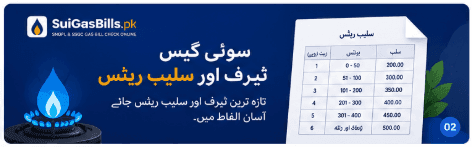
Protected Consumer Slab Rates — FY 2025-26
| Monthly Consumption (m³) | Rate per m³ (Rs) | Max Charge for Slab (Rs) |
|---|---|---|
| 0–50 m³ | Rs 11/m³ | Rs 550 |
| 51–90 m³ | Rs 22/m³ | Rs 880 |
| Above 90 m³ | Rs 42/m³ | Varies |
Non-Protected Consumer Slab Rates — FY 2025-26
| Monthly Consumption (m³) | Rate per m³ (Rs) | Max Charge for Slab (Rs) |
|---|---|---|
| 0–50 m³ | Rs 30/m³ | Rs 1,500 |
| 51–100 m³ | Rs 44/m³ | Rs 2,200 |
| 101–200 m³ | Rs 80/m³ | Rs 8,000 |
| 201–300 m³ | Rs 112/m³ | Rs 11,200 |
| 301–400 m³ | Rs 132/m³ | Rs 13,200 |
| Above 400 m³ | Rs 156/m³ | Varies |
Source: OGRA Determination for FY 2025–26. Rates are Rs per m³ (cubic metre) — indicative blended approximation. Official bills use MMBTU with GCV conversion.
Official OGRA Domestic Tariff — Rs per MMBTU (as gazetted)
This is the literal Schedule I / Schedule II rate table SNGPL and SSGC bill against — no cubic-metre conversion or GCV assumption applied. Your official bill converts your meter's m³ reading to MMBTU using your area's Gas Calorific Value (GCV), so this is the most exact reference available short of your own bill.
Protected — fixed charge Rs 600/month + Rs 40/month meter rent
| Consumption slab | Rate (Rs/MMBTU) |
|---|---|
| 0–0.25 hm³ (0–25 m³) | Rs 200 |
| 0.25–0.5 hm³ (25–50 m³) | Rs 250 |
| 0.5–0.6 hm³ (50–60 m³) | Rs 300 |
| 0.6–0.9 hm³ (60–90 m³) | Rs 350 |
Non-Protected — fixed charge Rs 1,500/month (≤1.5 hm³) or Rs 3,000/month (>1.5 hm³) + Rs 40/month meter rent
| Consumption slab | Rate (Rs/MMBTU) |
|---|---|
| 0–0.25 hm³ (0–25 m³) | Rs 500 |
| 0.25–0.6 hm³ (25–60 m³) | Rs 850 |
| 0.6–1.0 hm³ (60–100 m³) | Rs 1,250 |
| 1.0–1.5 hm³ (100–150 m³) | Rs 1,450 |
| 1.5–2.0 hm³ (150–200 m³) | Rs 1,900 |
| 2.0–3.0 hm³ (200–300 m³) | Rs 3,300 |
| 3.0–4.0 hm³ (300–400 m³) | Rs 3,800 |
| Above 4.0 hm³ (above 400 m³) | Rs 4,200 |
Source: SSGC Domestic Rates — official notification, effective 1 July 2025, verified 4 July 2026. SNGPL applies the same nationally uniform domestic schedule — independently confirmed against SNGPL's own published Slab 4 rates (Rs 350/MMBTU protected, Rs 1,450/MMBTU non-protected), which match exactly.
Bill Calculation Guide
How the Sui Gas Slab System Calculates Your Monthly Bill
The most common misconception about Pakistan's gas slab system is that your entire consumption is charged at the rate of the highest slab you reach. This is incorrect. Pakistan uses a marginal slab system, identical in principle to income tax brackets — each tier's rate applies only to the units consumed within that tier. Understanding this distinction can prevent confusion and help consumers correctly verify their bills.
The calculation process has four steps: (1) split total consumption across the applicable slabs, (2) calculate the energy charge for each slab and sum them, (3) add the applicable fixed monthly charge, and (4) apply GST at 18% on the total of the energy charge and fixed charge. The resulting figure is your estimated monthly gas bill before any arrears, adjustments, or surcharges that SNGPL or SSGC may apply separately.
Let us walk through two detailed worked examples — one for a protected consumer and one for a non-protected consumer — to illustrate exactly how the calculation works in practice.
Example 1: Protected Consumer — 120 m³
| Slab | Units | Rate | Amount |
|---|---|---|---|
| 0–50 m³ | 50 m³ | Rs 11 | Rs 550 |
| 51–90 m³ | 40 m³ | Rs 22 | Rs 880 |
| Above 90 m³ | 30 m³ | Rs 42 | Rs 1,260 |
| Energy Charge | 120 m³ | Rs 2,690 | |
| Fixed Charge | Protected | Rs 600 | |
| Subtotal | Rs 3,290 | ||
| GST (18%) | Rs 592.20 | ||
| Estimated Total | Rs 3,882.20 | ||
Example 2: Non-Protected Consumer — 200 m³
| Slab | Units | Rate | Amount |
|---|---|---|---|
| 0–50 m³ | 50 m³ | Rs 30 | Rs 1,500 |
| 51–100 m³ | 50 m³ | Rs 44 | Rs 2,200 |
| 101–200 m³ | 100 m³ | Rs 80 | Rs 8,000 |
| Energy Charge | 200 m³ | Rs 11,700 | |
| Fixed Charge | Non-Protected ≤150 | Rs 1,500 | |
| Subtotal | Rs 13,200 | ||
| GST (18%) | Rs 2,376 | ||
| Estimated Total | Rs 15,576 | ||
Note: The above calculations are illustrative and based on the indicative m³ rates. Your actual SNGPL or SSGC bill may differ due to GCV-based MMBTU conversion, meter reading adjustments, arrears, late payment surcharges, and any applicable subsidies or rebates. Use our gas bill calculator for a more detailed personalised estimate.

Protected Category
Protected Consumer Tariff — Who Qualifies and What They Pay
The “protected consumer” designation is Pakistan's primary mechanism for providing energy affordability to low-income households. The federal government, through the Ministry of Energy (Petroleum Division), defines the eligibility criteria for protected status, and OGRA incorporates subsidised rates into the annual tariff determination accordingly.
According to current OGRA guidelines, a domestic gas consumer is classified as protected if they meet specific criteria related to their household income level and consumption pattern. In practice, the protected category encompasses a large segment of Pakistani households — particularly those in smaller towns, semi-urban areas, and lower-income urban localities across Punjab, KP, Sindh, and Balochistan. Communities reliant on SNGPL in cities like Gujrat, Sahiwal, Dera Ghazi Khan, and Abbottabad, and SSGC customers in Larkana, Mirpurkhas, and Hub, often fall within the protected bracket.
The protected tariff structure for FY 2025–26 is as follows: households consuming up to 50 m³ per month pay Rs 11 per m³, those consuming between 51 m³ and 90 m³ pay Rs 22 per m³ on the additional units, and any consumption beyond 90 m³ is billed at Rs 42 per m³. The fixed monthly charge for protected consumers is Rs 600 — significantly lower than the Rs 1,500 or Rs 3,000 charged to non-protected consumers.
Protected status is determined at the time of new connection or upon application to your gas company. If you believe you qualify but are currently billed under the non-protected category, you may apply to your local SNGPL or SSGC customer service centre with supporting documentation — typically a CNIC, proof of residence, and income evidence. Incorrect categorisation is one of the most common causes of billing disputes in Pakistan, and consumers are encouraged to verify their status on their monthly bill or through the utility's online portal.
It is worth noting that protected consumers who habitually exceed the 90 m³ threshold may come under scrutiny by their gas company, as very high consumption relative to protected status can trigger reclassification. SNGPL and SSGC periodically audit consumer categories to ensure subsidy targeting remains accurate. Consumers who are reclassified receive written notice and have the right to appeal through OGRA's consumer complaint mechanism.
Rs 11
First Slab Rate
0–50 m³ per month for protected consumers
Rs 600
Fixed Monthly Charge
Regardless of consumption level
Rs 42
Maximum Slab Rate
Applies only to consumption above 90 m³
Non-Protected Category
Non-Protected Consumer Tariff — Higher Rates and How to Transition
The non-protected domestic tariff applies to households that do not meet the criteria for the protected (low-income) designation. This category includes middle- and upper-income families, larger homes, and households whose consumption patterns place them outside the welfare-targeting parameters used by OGRA. In large metropolitan areas such as Karachi, Lahore, Islamabad, and Rawalpindi, a substantial proportion of domestic gas consumers fall under the non-protected category.
The non-protected slab schedule for FY 2025–26 contains six tiers. Consumption of 0–50 m³ is billed at Rs 30/m³, the 51–100 m³ band at Rs 44/m³, the 101–200 m³ band at Rs 80/m³, the 201–300 m³ band at Rs 112/m³, the 301–400 m³ band at Rs 132/m³, and any consumption exceeding 400 m³ at Rs 156/m³. The significant jump in rates at the 101–200 m³ slab — from Rs 44 to Rs 80 per m³ — is by design: it discourages wasteful consumption during peak winter months and signals the boundary between essential and comfort use.
Fixed charges for non-protected consumers are tiered by consumption: households consuming up to 150 m³ per month pay a fixed charge of Rs 1,500, while those exceeding 150 m³ pay Rs 3,000. This means a consumer hovering just above the 150 m³ threshold is effectively penalised with an additional Rs 1,500 in fixed charges — a strong incentive to implement conservation measures to stay below this break-even point.
If you are currently a non-protected consumer but believe you qualify for protected status — for example, you are a low-income household or live in a modest residence — you can apply for reclassification at your nearest SNGPL or SSGC customer service centre or regional office. The process typically requires submitting your Consumer Number, CNIC, a recent gas bill, and documentation supporting your income level. SNGPL and SSGC may conduct a field verification visit before granting protected status.
Conversely, if your consumption has declined substantially — perhaps due to installation of solar water heating, improved insulation, or reduced household size — and you remain in the non-protected category, you may also benefit from strategic load management to avoid the higher upper slabs. The section on gas conservation later in this page provides actionable tips to reduce consumption and keep your bill manageable under the non-protected tariff.
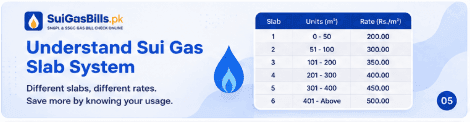
Rs 30
Entry Slab Rate
First 50 m³ for non-protected consumers
Rs 156
Highest Slab Rate
Consumption above 400 m³ per month
Rs 1,500
Fixed Charge (≤150 m³)
For non-protected consumers up to 150 m³
Rs 3,000
Fixed Charge (>150 m³)
For non-protected consumers above 150 m³
Charges & Taxes
Fixed Monthly Charges, 18% GST and Other Fees on Your Gas Bill
The variable energy charge — the per-m³ amount calculated using the slab rates — is only one component of your total monthly gas bill. Understanding the complete fee structure is essential to reconciling your bill and identifying any errors. Pakistani gas bills typically contain several distinct line items beyond the base energy charge.
Fixed Monthly Charge (FMC): This is a non-consumption-linked standing charge intended to recover the fixed infrastructure costs of maintaining pipelines, meters, and distribution networks. For protected consumers it is a flat Rs 600 per month regardless of how much gas they consume. For non-protected consumers, the FMC is Rs 1,500 for monthly consumption up to 150 m³ and jumps to Rs 3,000 for consumption exceeding 150 m³. The FMC is levied even in months when gas supply is interrupted, which has historically been a source of consumer grievances before OGRA.
General Sales Tax (GST) at 18%: GST is levied under the Sales Tax Act 1990 and applies to the combined sum of the energy charge and the fixed monthly charge. At 18%, GST forms a significant portion of your bill — for a non-protected household spending Rs 10,000 in energy and fixed charges, GST alone adds Rs 1,800. GST is collected by SNGPL and SSGC on behalf of the Federal Board of Revenue (FBR).
Meter Rent: SNGPL and SSGC charge a monthly meter rent (typically a small amount of a few hundred rupees) for the gas meter installed on your premises. This charge appears as a separate line item on your bill and is also subject to GST.
Late Payment Surcharge (LPS): If you fail to pay your bill by the due date printed on it, a late payment surcharge is applied at a rate set by OGRA. This surcharge compounds on unpaid balances and can accumulate significantly over time, particularly for consumers who defer payment during financial hardship.
Complete Summary of Charges on a Sui Gas Bill
| Charge Type | Protected | Non-Protected (≤150 m³) | Non-Protected (>150 m³) |
|---|---|---|---|
| Energy Charge | Rs 11–42/m³ (marginal) | Rs 30–80/m³ (marginal) | Rs 30–156/m³ (marginal) |
| Fixed Monthly Charge | Rs 600 | Rs 1,500 | Rs 3,000 |
| GST | 18% on (Energy + FMC) | 18% on (Energy + FMC) | 18% on (Energy + FMC) |
| Meter Rent | Per meter type | Per meter type | Per meter type |
| Late Payment Surcharge | If overdue | If overdue | If overdue |
| Prior Period Adjustment | If applicable | If applicable | If applicable |
GST is levied under the Sales Tax Act 1990 at 18% and collected by SNGPL/SSGC on behalf of the Federal Board of Revenue (FBR), Islamabad.
Regulatory Framework
OGRA — The Regulator That Sets Gas Tariffs in Pakistan
The Oil and Gas Regulatory Authority (OGRA) was established through the OGRA Ordinance 2002 with the principal mandate of fostering a competitive environment in the downstream petroleum and natural gas sectors in Pakistan. Headquartered in Islamabad, OGRA operates as an independent quasi-judicial body under the Ministry of Energy (Petroleum Division) and its decisions carry the force of law.
OGRA's tariff-setting process for domestic gas follows a structured annual cycle. Each year, SNGPL and SSGC file their Annual Revenue Requirement (ARR) petitions with OGRA. These petitions detail the companies' operating costs, capital expenditure, depreciation, return on assets, and projected gas volumes. OGRA scrutinises these submissions, invites public comments, and holds formal hearings where consumer advocacy groups, industry associations, and government ministries can present evidence and arguments. This consultative process is designed to balance the utilities' financial sustainability with the consumers' affordability concerns.
After the hearing process, OGRA issues a Determination Order which sets the allowed revenue for each utility and translates this into the slab rates and fixed charges that appear on your gas bill. The Determination is then published in the official Pakistan Gazette, giving it legal effect from the notified date — typically July 1 of the new financial year. Both SNGPL and SSGC are legally bound to implement these tariffs without modification.
OGRA also handles consumer complaints. If you believe your gas bill contains errors, if you have been wrongly categorised as non-protected, or if you have a dispute with SNGPL or SSGC regarding connections, meters, or billing, you have the right to file a formal complaint with OGRA after exhausting the utility company's internal complaint resolution process. OGRA's Consumer Complaint Cell is reachable through its Islamabad headquarters and through regional offices in Lahore, Karachi, Peshawar, and Quetta.
In addition to tariff-setting, OGRA licenses new gas distribution and transmission companies, approves tariffs for liquefied petroleum gas (LPG) distributors, and monitors safety and service quality standards across the sector. The Authority publishes quarterly and annual reports on gas sector performance, which are publicly available on the OGRA website and serve as an important resource for researchers, journalists, and policy advocates tracking energy affordability in Pakistan.
2002
OGRA Established
Under the OGRA Ordinance 2002
2
Gas Utilities Regulated
SNGPL (North) and SSGC (South)
Annual
Tariff Review Cycle
ARR petitions filed every financial year
Public
Hearing Process
Open hearings in Islamabad before determination

Official Notifications
How to Read Gas Tariff Notifications from SNGPL and SSGC
When OGRA finalises its annual Determination, the government formalises the new tariff through a Statutory Regulatory Order (SRO) issued by the Ministry of Energy (Petroleum Division) and published in the Pakistan Gazette. These gazette notifications are the authoritative legal source of gas tariff rates in Pakistan and supersede any other published figure, including those on utility websites or media reports.
A typical gas tariff SRO contains several sections. The preamble identifies the issuing authority (Ministry of Energy — Petroleum Division), the legal basis (Natural Gas Regulatory Authority Act or OGRA Ordinance), and the effective date. The operative schedules then list the domestic, commercial, industrial, and CNG tariff tables. For domestic consumers, you will find two main tables: Schedule I (Domestic — Protected) and Schedule II (Domestic — Non-Protected), each showing the slab bands, per-unit rates, and fixed charges.
To find the current official notification, visit the OGRA website and navigate to the “Tariffs” or “Determinations” section. SNGPL publishes tariff schedules on its website (sngpl.com.pk) under the “Consumers” section, and SSGC does the same at ssgc.com.pk. The Pakistan Gazette is also searchable through the National Assembly's legislative resource portal.
When comparing tariff notifications across years, pay attention to the effective date, the consumer category definitions (which may change), and whether mid-year revision notifications exist. OGRA has in the past issued revised determinations after court orders, fuel adjustment challenges, or federal government directives — so a July notification may be followed by an October or January amendment. Always check for the most recent gazette notification to ensure you are using current rates.
Tariff History
Sui Gas Tariff History — Rate Trends and Impact on Pakistani Households
The history of Pakistan's gas tariffs is intimately linked to the country's macroeconomic trajectory and its relationship with international financial institutions. For much of the 1990s and early 2000s, gas tariffs were set at politically palatable levels that did not fully recover the cost of gas procurement, transportation, and distribution — resulting in chronic circular debt accumulation in the energy sector. By the mid-2010s, this circular debt had become a serious macroeconomic constraint, and international creditors including the International Monetary Fund (IMF) and World Bank began requiring Pakistan to implement cost-recovery pricing reforms as conditions of financial assistance.
In the period between FY 2015–16 and FY 2020–21, domestic gas tariffs increased substantially — particularly for non-protected consumers. The first 50 m³ entry rate for non-protected consumers, for example, rose from approximately Rs 6–8/m³ in the mid-2010s to Rs 30/m³ by FY 2025–26. Protected consumer rates also rose, but at a more moderate pace reflecting the government's commitment to shielding the most vulnerable. Fixed charges approximately doubled or tripled over the same period.
The impact on Pakistani households has been significant. For families in Lahore and Karachi who rely heavily on gas for cooking, water heating, and space heating, gas bills that were Rs 500–800 per month in 2012 have risen to Rs 3,000–8,000 per month or more by 2025, depending on consumption. This increase has contributed to a shift toward alternative fuels — LPG cylinders, electric induction cooktops, and solar water heaters — particularly in urban middle-class households. The government has periodically announced relief packages, targeted subsidies, and consumption smoothing schemes to mitigate the impact of these increases.
Looking forward, Pakistan's gas tariff trajectory will depend on several factors: the pace of indigenous gas field depletion, LNG import costs, the efficiency of SNGPL and SSGC operations, and the political economy of energy subsidies. The transition toward regasified LNG (RLNG) from the Qatar and other international supply contracts has introduced a dollar-linked cost component that makes PKR-denominated tariffs inherently more volatile when the rupee depreciates.
200%+
Rate Increase Since 2015
Non-protected consumer rates over 10 years
IMF
Reform Driver
Cost-recovery pricing required by IMF programs
LNG
Price Pressure
Dollar-linked RLNG costs drive future volatility

Conservation Guide
10 Ways to Reduce Your Gas Bill Under the Slab System
Pakistan's progressive slab system means that the marginal value of conservation is highest when you are consuming in the upper slabs. For a non-protected household consuming 220 m³ per month, reducing consumption by 20 m³ saves not only the cost of those 20 m³ at Rs 112/m³ (Rs 2,240) but can also push the total below a fixed charge threshold, saving an additional Rs 1,500. Strategic conservation — targeted at pushing your total consumption below key slab and threshold boundaries — offers the highest financial return.
The following ten strategies are actionable, low-cost, and effective for households across Karachi, Lahore, Islamabad, and every other Pakistani city served by SNGPL or SSGC. Some require upfront investment; most require only behavioural change.
1. Fix Gas Leaks Immediately
A leaking gas fitting — even a minor drip from a hose connection or a valve that does not fully close — can waste tens of cubic metres per month without contributing to any actual cooking or heating. Contact an SNGPL- or SSGC-approved plumber to conduct a pressure test on your internal gas network. Fix all leaks promptly. Beyond saving money, this is a critical safety measure, as undetected leaks are a leading cause of household gas explosions in Pakistan.
2. Use a Pressure Cooker
Pressure cookers reduce cooking time by 50–70% compared to conventional pots. For households cooking dal, rice, meat, and legumes multiple times a day — a typical Pakistani cooking pattern — switching to a pressure cooker can reduce gas consumption for cooking by 2–4 m³ per month. Over a year, this can save Rs 3,000–Rs 6,000 for a non-protected consumer in the upper slabs.
3. Install a Solar Water Heater
Water heating for bathing and dishwashing is one of the largest consumers of gas in Pakistani households, particularly in winter. A solar water heater (SWH) system can provide 60–80% of a household's hot water needs from free solar energy. With Pakistan receiving 5–7 peak sun hours per day in most regions, SWH systems typically pay back their cost in 3–5 years through gas savings. AEDB and SECP have periodically offered incentive schemes for SWH adoption.
4. Maintain Your Gas Appliances
Gas stove burners with clogged ports, water heaters with lime-scale buildup, and gas room heaters with dirty burners all operate at reduced efficiency — consuming more gas for the same output. Annual servicing of gas appliances by a licensed technician ensures they operate at optimal efficiency. A properly calibrated stove burner can be 15–25% more gas-efficient than a neglected one.
5. Use Pot Lids When Cooking
Cooking with pot lids on significantly reduces the time required to boil water and cook food, directly reducing gas consumption. Studies in South Asian cooking contexts suggest that consistent use of lids can reduce cooking-related gas consumption by 10–15%. This zero-cost behavioural change can save 0.5–1 m³ per month — modest in isolation, but meaningful when combined with other measures.
6. Insulate Your Water Pipes and Geyser
In winter, uninsulated hot water pipes lose heat rapidly between the geyser and the tap. By the time hot water arrives at a distant bathroom, much of the thermal energy has been lost to the environment. Insulating your hot water pipes and wrapping your geyser tank with a thermal blanket reduces heat loss, meaning your geyser runs fewer cycles per day. Pipe insulation materials are inexpensive and widely available in hardware markets across Pakistan.
7. Adjust Your Geyser Temperature
Many households set their gas geysers to the maximum temperature and then dilute the output with cold water. This wastes gas heating water beyond the useful temperature. Setting your geyser thermostat to 55–60°C (rather than 70–80°C) reduces the energy input required while still providing comfortable bathing water. Avoid setting it below 55°C, as temperatures below that range can allow harmful bacteria to grow in the tank.
8. Monitor Your Monthly Meter Reading
Take a meter reading at the start and end of each month and track your consumption trend. Many consumers are unaware of their actual monthly consumption until they receive a large bill. Self-monitoring helps you identify unusual spikes — which may indicate a leak, a new appliance consuming more than expected, or a billing error — before they accumulate. SNGPL and SSGC both provide consumer portals where you can view your billing history and consumption data.
9. Reduce Space Heater Usage
Gas room heaters and gas-fired central heating systems can be the single largest gas consumers in a household during winter months, easily pushing consumption into the upper slabs. Consider supplementing with electric heaters, particularly during shoulder months (October–November and March–April) when temperatures are mild. Using heavy curtains and door draft excluders to retain heat reduces the run time of gas heaters without sacrificing comfort. In cities like Lahore, Islamabad, and Peshawar where winters are cold, this trade-off requires careful management.
10. Consider a Gas Bill Calculator Before Large Decisions
Before purchasing a new gas appliance, adding a gas connection point, or renting a larger property, use a gas bill calculator to estimate the likely impact on your monthly bill. The non-linear nature of Pakistan's slab system means that the effective cost of each additional cubic metre varies dramatically depending on your total consumption level. A household sitting just below the 150 m³ non-protected threshold, for example, should carefully evaluate any decision likely to push them above it — the combined impact of the rate increase and the fixed charge jump to Rs 3,000 can add Rs 3,000–Rs 5,000 per month.