
What the Due Date on Your Sui Gas Bill Actually Means
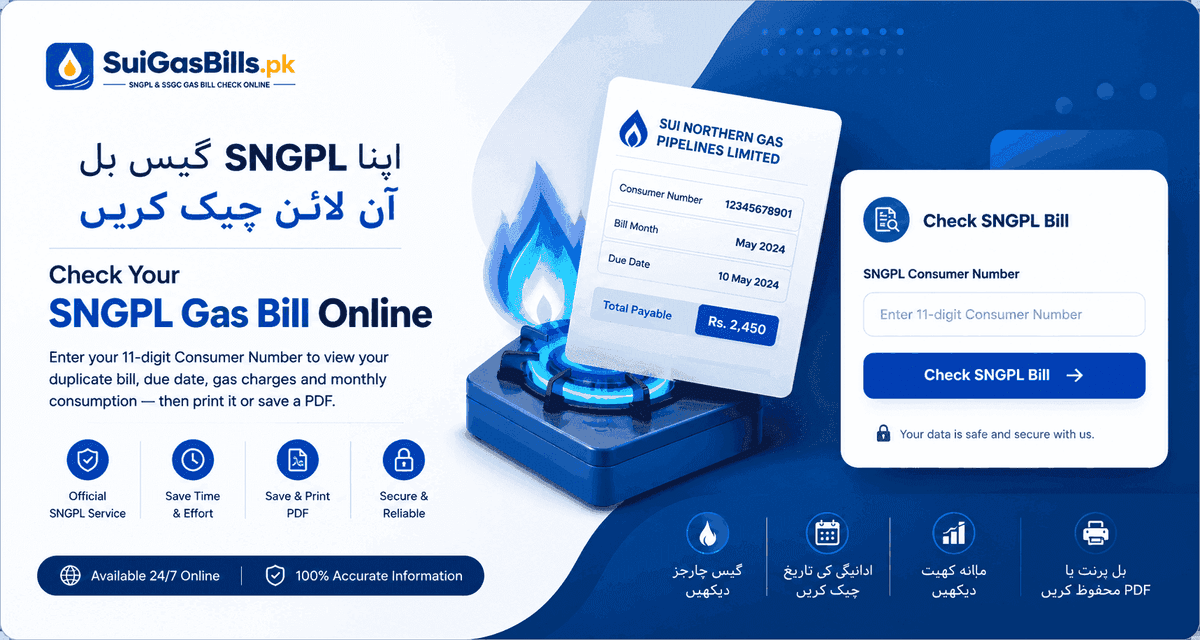
Every Sui Gas bill prints a clearly marked due date — the last calendar day on which you can pay the lower amount without penalty. This date is normally about 30 days from the bill issue date, giving households a full month to arrange payment. Whether you are an SNGPL consumer in Punjab or KPK checking through the SNGPL bill check page, or an SSGC consumer in Sindh using the SSGC bill check page, the due date sits near the total payable box so it is easy to spot before you pay.
The due date is not the same as the billing month or the meter reading date. It is a payment deadline set by the utility and approved under the framework the Oil and Gas Regulatory Authority oversees. When you check your Sui Gas bill online, the portal displays both the issue date and the due date; noting the gap between them tells you exactly how many days you have to pay. Missing this window is the single most common reason consumers end up paying more than they should.
It is worth understanding that the due date is fixed per billing cycle and does not roll over. If you pay one day late, the higher amount applies in full — there is no grace day. This is why we recommend saving a reminder as soon as your bill is generated. You can confirm the current amount and deadline anytime through the Sui Gas bill calculator for an estimate, or the official portal for the exact figure, and then schedule your payment a few days early.
'Payable Within Due Date' vs 'Payable After Due Date'
Sui Gas bills show two different amounts: 'payable within due date' and 'payable after due date'. The first is the true bill for the month. The second is higher because it already includes the Late Payment Surcharge (LPS) that applies if you miss the deadline. Consumers who check their bill on the SNGPL portal or the SSGC portal should always look at which figure applies to the date they intend to pay.
The difference between the two amounts is the surcharge itself. On a typical domestic bill this is a modest few hundred rupees, but on a high-consumption winter bill it can be substantial. If you want to see how consumption drives the base amount before any surcharge, run the numbers through the bill calculator; the surcharge is then layered on top of that base if you pay late. Understanding this split helps you decide whether paying immediately is worth avoiding the higher figure.
A common mistake is paying the 'after due date' amount when you are actually still within the window — some consumers assume the larger number is the correct one. It is not. Before the due date, only the lower amount is owed. If you are ever unsure which figure to pay, the safest route is to confirm through the official portal or call the Sui Gas complaint and helpline service and have staff read out the current payable amount for your account.
| Field on Bill | What It Means | When to Pay It |
|---|---|---|
| Payable Within Due Date | The true bill for the month, no penalty | On or before the due date |
| Payable After Due Date | Bill plus Late Payment Surcharge (LPS) | Only if the due date has passed |
| Due Date | Deadline for the lower amount | Aim to pay several days earlier |
| Arrears | Unpaid amount carried from prior months | Clear as soon as possible |
How the Late Payment Surcharge (LPS) Is Calculated
The Late Payment Surcharge is generally calculated as a percentage — commonly around 10% — of the current month's bill amount, and it is what turns the 'within due date' figure into the higher 'after due date' figure. The exact percentage and method are set within the tariff framework approved by OGRA, so the surcharge is a regulated charge, not an arbitrary penalty. You can review the underlying rate structure on the Sui Gas tariff page to see how charges are built up before the surcharge applies.
Because the surcharge is a percentage of the bill, larger bills attract a larger rupee surcharge. A modest summer bill might carry a small LPS, while a heavy winter bill — driven by geysers and heaters — carries a much bigger one. If you are trying to anticipate your winter costs, the bill calculator helps you estimate the base amount, and you can then picture roughly 10% on top as the cost of paying late. This is one more reason protected and non-protected consumers alike should pay on time.
It is important to note that surcharge figures and percentages are OGRA-set and indicative — they can be revised, and the amount printed on your official bill is always the authoritative one. If the difference between your two payable amounts looks larger than expected, verify it against the official figure and, if it still seems wrong, follow the overcharge and dispute process to have it reviewed rather than simply paying an amount you do not understand.
What Happens Step-by-Step When You Miss the Due Date
Missing the due date does not trigger instant disconnection — there is a sequence of stages, and understanding it helps you act before things escalate. The first stage is simply that the higher 'after due date' amount becomes payable, adding the LPS. At this point you can still resolve everything by paying promptly through any Sui Gas payment channel. Most consumers who occasionally slip a day or two never move beyond this first stage.
If the bill remains unpaid into the next billing cycle, the surcharged amount is carried forward as arrears and printed on your next bill alongside the new month's charges. Now you owe both the old surcharged amount and the fresh bill. Consumers who check their bill online will see this arrears line clearly. Continued non-payment across multiple cycles moves the account toward a formal disconnection notice, which the utility is entitled to issue under its terms of service.
The final stage is physical disconnection of the gas supply, followed by the requirement to pay all outstanding dues plus a reconnection charge before service is restored. This is disruptive and costly, especially in winter. If you are struggling to pay, contact SNGPL or SSGC early through the complaint and helpline service — raising the issue before disconnection is always cheaper and simpler than restoring a disconnected connection afterward.
- 1Due date passes — the higher 'after due date' amount (with LPS) applies
- 2Bill stays unpaid — the surcharged amount carries forward as arrears next month
- 3Multiple unpaid cycles — a formal disconnection notice may be issued
- 4Disconnection — gas supply is cut until dues and reconnection charges are cleared
- 5Reconnection — pay all outstanding plus reconnection fee via an approved channel
Disconnection and Reconnection: The Real Cost of Delay
Disconnection is the outcome every consumer wants to avoid, because restoring supply costs far more than the original bill. Once disconnected, you must pay the full outstanding balance — including every accumulated Late Payment Surcharge — plus a separate reconnection fee before the utility will schedule a field visit to restore your gas. Consumers can confirm their outstanding total on the SNGPL or SSGC portal before heading to a payment counter.
The reconnection process is not instant. After you clear all dues, a field team must be dispatched to physically restore the connection, and depending on the regional office workload this can take several working days. During winter, when demand is highest, delays are longer and being without gas is hardest. This timing gap is precisely why paying the lower 'within due date' amount on time is so much cheaper — in both money and inconvenience — than recovering from disconnection.
If disconnection was triggered by a bill you genuinely believe is wrong, do not simply pay under protest and lose the chance to challenge it. Pay what is needed to restore essential supply, but simultaneously open a formal case through the overcharge dispute process and the complaint helpline guide. A confirmed billing error can be adjusted on a later bill, but only if you have logged it properly with a complaint reference number.
How to Avoid Late Fees Every Month
Avoiding the Late Payment Surcharge is straightforward once you build a simple routine around your billing cycle. The most reliable habit is to check your bill as soon as it is issued rather than waiting for the paper copy — you can check any Sui Gas bill online within minutes using your consumer number. Knowing the amount and due date early gives you the whole month to arrange funds, instead of scrambling in the final days.
Digital payment channels make on-time payment effortless. Mobile wallets like JazzCash and Easypaisa reflect payment the same day, so you can pay right up to the due date and still be safe; the full list of options is covered in the Sui Gas bill payment methods guide. If you prefer bank counters or 1Link ATMs, remember these take 2–3 working days to reflect, so pay earlier to be safe. Choosing the right channel for your timing is half the battle against late fees.
For consumers who repeatedly forget, set a recurring monthly phone reminder for a few days before your typical due date, and save a photo of your bill so your consumer number is always handy. If you ever cannot locate your bill, the duplicate bill page regenerates it instantly. Building these small habits eliminates almost all late-payment surcharges, keeping every bill at the lower 'within due date' amount.
- Check the bill the day it is issued via the online bill check
- Set a phone reminder 3–5 days before the due date
- Use JazzCash or Easypaisa for same-day reflection
- If paying by bank or ATM, pay early to allow 2–3 working days
- Save a photo of your bill or use the duplicate bill tool so your number is always ready
Partial Payments: Do They Help?
Many consumers ask whether a partial payment helps when they cannot pay the full bill by the due date. The honest answer is that a partial payment reduces your outstanding balance and therefore the base on which future surcharges are calculated, but it does not stop the surcharge on the unpaid portion. If you can only pay part, paying something before the due date is still better than paying nothing, and you can top up the balance through any approved payment channel as soon as funds allow.
It is important to be realistic: a partial payment does not reset the due date or pause the escalation toward disconnection. The remaining balance still ages into arrears and can still trigger notices if left too long. If you foresee an ongoing difficulty paying, the better step is to contact your utility through the complaint and helpline service and explain your situation, rather than relying on repeated partial payments that leave a rolling balance.
Consumers on protected status — whose lower rates are explained on the protected consumer status guide — sometimes find their bill spikes in winter and becomes hard to clear at once. In that case, verify you are still correctly classified using the protected status checker; an incorrect non-protected classification can inflate a bill unnecessarily and is worth disputing before you resign yourself to partial payments on an inflated amount.
Troubleshooting: Paid On Time But Still Shows as Due
A frequent worry is seeing a bill still marked unpaid — or even surcharged — after you have already paid. In most cases this is simply a reflection delay, not a lost payment. Bank counter and 1Link ATM payments take 2–3 working days to update in the utility's system, while JazzCash and Easypaisa usually reflect the same day. If you paid at a bank yesterday, wait the full reflection window before assuming anything is wrong, and keep checking through the online bill portal.
Always retain your payment receipt or transaction reference number, whether it is a printed bank slip, an ATM receipt, or a digital confirmation from a mobile wallet. This reference is your proof of payment and the single most useful thing to have when resolving a delay. If, after 2–3 working days, your SNGPL or SSGC account still shows the amount as outstanding, the reference number lets staff trace and manually credit your payment.
If the reflection window has passed and the payment is still not showing, call the complaint and helpline service with your consumer number and payment reference. Ask them to log a complaint and note the reference number they give you. Where a surcharge was wrongly applied because an on-time payment was recorded late, it can be reversed on a subsequent bill — the detailed route for this is in the overcharge dispute guide.
| Payment Channel | Typical Reflection Time | Keep for Proof |
|---|---|---|
| JazzCash / Easypaisa | Same day | In-app digital receipt |
| Internet Banking | 1–2 working days | Transaction reference number |
| 1Link ATM | 2–3 working days | Printed ATM slip |
| Bank Branch Counter | 2–3 working days | Stamped payment slip |
SNGPL vs SSGC: Due Dates and Surcharge Compared
Both major utilities operate the same fundamental system — a due date, a 'within due date' amount, and a higher 'after due date' amount with a Late Payment Surcharge — but consumers should use the correct company's channels. SNGPL serves Punjab, KPK, Islamabad, AJK and Gilgit-Baltistan with an 11-digit consumer number; verify amounts on the SNGPL bill check page. SSGC serves Sindh and Balochistan with a 10-digit customer number, checked on the SSGC bill check page.
The surcharge principle is identical for both: pay after the due date and the LPS applies on top of your bill. What differs is the contact channel for queries — SNGPL's 24/7 helpline is 111-762-762, while SSGC's is 1199, and both can be reached through the unified complaint and helpline service. A fuller comparison of the two companies, including coverage and account-number formats, is available in the SNGPL vs SSGC difference guide.
Regardless of which utility serves you, the tariff and surcharge figures are set within the framework approved by OGRA and are indicative and revisable — the official bill remains authoritative. If you are comparing your bill against expected charges, the Sui Gas tariff page and the bill calculator both work for SNGPL and SSGC consumers, letting you sanity-check the base amount before any surcharge is added.
Key Takeaways: Never Pay More Than You Owe
The core lesson is simple: pay the 'within due date' amount on or before the due date and you will never pay a surcharge. Everything else — arrears, escalating surcharges, disconnection notices, and reconnection fees — flows from missing that one deadline. Make checking your bill online the moment it is issued a monthly habit, and the rest takes care of itself. The lower amount is the only amount you should ever need to pay.
When life makes on-time payment impossible, act early rather than late. A partial payment before the due date, a call to the complaint and helpline service, or verifying your protected status can all reduce what you owe or buy you room to arrange funds. Silence and delay are what turn a manageable bill into a disconnection, so treat the due date as a prompt to engage, not a date to fear.
Finally, if a surcharge or high bill looks wrong, you have clear routes to challenge it: the overcharge dispute guide walks through verification and formal complaints, and the complaint helpline guide explains escalation to your regional office and OGRA. Combined with paying on time, these tools ensure you always pay exactly what you owe — never a rupee more.